 how-to
7 Common Causes of Uneven Tire Wear and How to Spot Them
Last Updated: November 2, 2026
Quick Summary
Uneven tire wear is the uneven loss of tread across a tire's surface, and it almost always points to a mechanical or maintenance problem rather than bad luck. Common causes include wrong tire pressure, bad alignment, unbalanced wheels, and worn shocks, struts, ball joints or tie rods. Match the wear pattern to the cause before paying for a repair.
- Both edges worn points to underinflation, while center wear points to overinflation.
- Feathered tread means an alignment problem; cupped or scalloped tread means worn shocks or struts.
- Check cold tire pressure monthly against the driver's door sticker, not the tire sidewall.
- Rotate your tires every 5,000 to 8,000 miles for even wear.
- Replace any tire at or below 2/32 inch, and treat under 4/32 inch as risky in wet weather.
Table of Contents
- Why Uneven Tire Wear Happens and Why It Matters
- Tire Wear Patterns and Causes Chart: Match the Pattern to the Problem
- Tire Pressure Problems: Underinflation and Overinflation
- What Causes Uneven Tire Wear on the Inside Edge
- Wheel Alignment, Balance, and Worn Suspension Parts
- Uneven Tire Wear Vibration: What Your Steering Wheel Is Telling You
- Driving Habits, Load, and Road Conditions That Accelerate Wear
- How to Fix Uneven Tire Wear: A Step-by-Step Plan
- Frequently Asked Questions
Why Uneven Tire Wear Happens and Why It Matters
Uneven tire wear is the uneven loss of tread across a tire's surface, and it almost always points to a mechanical or maintenance problem rather than bad luck.
Tires are expensive. A set that wears evenly can last years. A set that wears on one edge can be ruined in months.
The good news? Most causes are fixable, and you can spot them yourself with a coin and a flashlight.
Tire Wear Patterns and Causes Chart: Match the Pattern to the Problem
Tire wear patterns are the shapes worn into your tread, and each shape points to a specific cause. Match what you see to the chart below, then use the inspection sequence that follows to confirm the cause before you pay for a repair.
| Wear Pattern | Likely Cause | What to Check | Typical Tread Depth Reading |
|---|---|---|---|
| Both edges worn | Underinflation | Tire pressure | Edges 2/32-4/32 inch lower than center |
| Center worn | Overinflation | Tire pressure | Center 2/32-4/32 inch lower than edges |
| One inner edge | Camber or toe problem | Alignment | Inner shoulder at or below 2/32 inch while outer is 6/32 inch or more |
| One outer edge | Camber or toe problem | Alignment | Outer shoulder at or below 2/32 inch while inner is 6/32 inch or more |
| Cupped or scalloped | Worn shocks or struts | Suspension | Dipped spots 1/32-2/32 inch below surrounding tread at regular intervals |
| Feathered tread | Bad toe setting | Alignment | One side of each tread block 1/32-2/32 inch lower than the other |
| Patchy bald spots | Unbalanced wheel | Wheel balance | Isolated spots at or below 2/32 inch with 5/32 inch or more nearby |
How to Measure Tread Depth Yourself
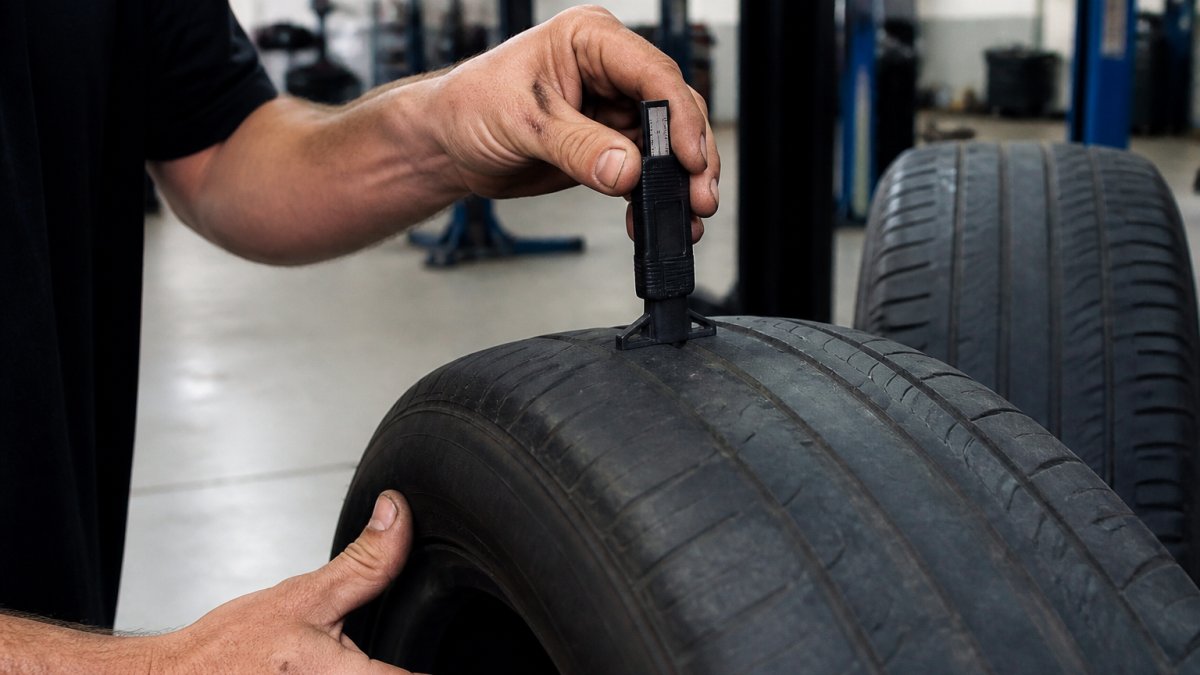
A tread depth gauge gives you a number you can compare across all four tires. Insert the probe into the center groove and both shoulder grooves of each tire, and write down all three readings. If you do not have a gauge, a penny works: insert Lincoln's head upside down into the groove. If the top of his head is visible, you are at or below 2/32 inch and the tire needs replacement. If you can see the top of his head in the 4/32 inch range, treat the tire as marginal in wet weather.
A common pattern is a tire that reads 6/32 inch in the center and 3/32 inch on both shoulders. That 3/32 inch difference is the signature of chronic underinflation, not a manufacturing defect.
How to Tell Similar Wear Patterns Apart
Cupping and feathered wear look alike at a glance. Here is the difference.
Run your hand slowly across the tread. Feathered wear feels sharp one way and smooth the other, like a saw blade.
Feathering means alignment. Cupping means suspension. Getting this wrong sends you to the wrong repair.
A second pair that gets confused: inner-edge camber wear and inner-edge toe wear. Camber wear is a smooth taper across the shoulder.
The At-Home Inspection Sequence
Work through these steps in order so you do not chase the wrong cause:
- Measure tread depth at the center and both shoulders of all four tires. Record the numbers.
- Check cold tire pressure against the driver's door sticker and note any tire more than 3 psi off spec.
- Feel each tread surface for feathering or cupping.
- Look for the wear indicator bars molded into the grooves. If tread is flush with them, the tire is at 2/32 inch and is done.
- Note symptoms, pull, shake, or vibration, and when they occur.
Watch out: a tire worn to 2/32 inch or below can hydroplane in standing water even if it looks fine from the side, so do not delay replacement to finish the diagnosis.
Tire Pressure Problems: Underinflation and Overinflation
Tire pressure is the most common and cheapest cause to rule out. Check it monthly, when the tires are cold.
Underinflation makes the tire sag. Both outer edges press the road while the center rides high, so both shoulders wear fast.
Overinflation does the opposite. The center bulges out and wears while the edges barely touch. You lose grip, too.
Follow the pressure on the driver's door sticker, not the number on the tire sidewall. The NHTSA tire safety guidance explains why the vehicle placard is the correct spec.
What Causes Uneven Tire Wear on the Inside Edge
Inside edge wear almost always means the top of the tire leans inward. That lean is a camber problem, and it often comes from a bent suspension part after a pothole or curb hit.
Worn ball joints and tie rods cause it too. So does a car that is regularly overloaded.
You often cannot see inner edge wear from the side. Reach under and feel the inside shoulder, or ask for a photo-backed inspection.
Camber, Toe, and Caster Explained in Plain Terms
Camber is how the top of the tire tilts in or out. Too much tilt wears one edge.
Toe is whether the tires point straight ahead or slightly in or out.
Caster is the steering axis tilt that helps your car track straight. It rarely wears tires by itself but affects handling.
If these terms are new to you, our auto repair dictionary explains them in plain language.
Wheel Alignment, Balance, and Worn Suspension Parts
Alignment sets the wheels straight. Balance stops vibration. Suspension holds it all together. All three affect how your tread wears.
A wheel alignment adjusts camber, toe, and caster to factory spec.
Wheel balance is different. Small weights offset heavy spots in the tire and wheel. Skip it and you get patchy bald spots and a shaking wheel.
Worn shocks and struts let the tire bounce instead of staying planted. That produces cupping.
Uneven Tire Wear Vibration: What Your Steering Wheel Is Telling You
Uneven tire wear vibration is a shake you feel through the wheel or seat, and it usually means balance or a damaged tire. A shake at highway speed points to balance. A shake while braking points to warped rotors or worn suspension.
A pull to one side points to alignment or a dragging brake.
Do not ignore it. Vibration speeds up wear and stresses steering parts. Have it checked before it becomes a bigger bill.
Driving Habits, Load, and Road Conditions That Accelerate Wear
How you drive shapes how your tires wear. Hard cornering scrubs the outer shoulders. Fast starts spin the front tires. Hard braking flat-spots them.
Load matters too. A trunk full of tools every day pushes past the load capacity and changes alignment angles.
Rotate your tires on schedule. Most makers call for a rotation every 5,000 to 8,000 miles, and the Tire Industry Association rotation guidance backs regular rotation for even wear.
How to Fix Uneven Tire Wear: A Step-by-Step Plan
Fixing uneven tire wear starts with measuring, then matching the fix to the cause. Here is the plan we walk customers through, including what each repair actually corrects and when to stop driving.
Total time: 20 minutes to inspect, then a shop visit for the repair.
What you'll need: a tread depth gauge or a penny, a tire pressure gauge, and a flashlight.
- Measure tread depth. Check the center and both edges of each tire. Below 2/32 inch means replace it. Under 4/32 inch in wet weather is risky.
- Check pressure cold. Compare each tire to the door sticker. Fill or release air as needed.
- Feel the tread. Sharp on one side means feathering. Scooped bowls mean cupping.
- Note the symptoms. Write down any pull, shake, or vibration and when it happens.
- Book an inspection. Alignment, balance, and suspension checks need a shop.
What Each Fix Corrects
An alignment adjusts camber, toe, and caster back to factory spec, which stops edge and feathered wear. You can see the shop's alignment and suspension services and book them. A wheel balance adds weights to offset heavy spots, which stops patchy bald spots and highway shake. New shocks and struts restore the damping that keeps the tire planted, which stops cupping. Replacing worn ball joints and tie rods removes the play that lets alignment drift within miles.
When to Stop Driving and When You Can Wait
Stop driving and arrange an inspection or replacement if any tire is at or below 2/32 inch, if you can see cords or the wear indicator bars are flush with the tread, if a bulge or sidewall crack appears, or if the vibration is severe enough to affect steering. You can usually drive cautiously to a shop if the wear is uneven but above 4/32 inch and there is no bulge, cord, or severe shake.
Rotation and Inspection Schedule
Rotate your tires every 5,000 to 8,000 miles, and check pressure monthly when the tires are cold. The Tire Industry Association rotation guidance backs regular rotation for even wear, and the NHTSA tire safety guidance explains why the vehicle placard is the correct pressure spec.
Some drivers need an alignment, a balance, or a suspension part, and some need all three. When you're ready, book service or reach the shop and we'll get you scheduled.
Frequently Asked Questions
What is the main cause of uneven tire wear?
Incorrect tire pressure and misalignment are the two most common culprits. Underinflation wears both outer edges, overinflation wears the center, and misalignment typically chews one edge of a single tire. Suspension wear, unbalanced tires, and hard driving habits follow close behind. Because several causes produce overlapping patterns, the fastest way to confirm the real source is a tread-depth reading at three points across each tire plus an alignment check, which is exactly what a photo-backed inspection documents.
Is it bad to drive on tires with uneven wear?
Yes, and the risk grows with the severity. Uneven tire wear reduces traction in wet conditions, lengthens stopping distances, and can cause vibration or pulling that affects steering control. Worn inner or outer edges also expose the tire's sidewall and belt edges to damage. If any groove measures at or near 2/32 inch, the tire is legally worn out and should be replaced before highway driving. Get an inspection promptly if you notice cupping, exposed cords, or a vibration that worsens with speed.
Can uneven tire wear cause vibration?
It can. Uneven tire wear vibration usually comes from cupping, scalloping, or flat spots, which create high and low spots that thump against the road at speed. A wheel that has lost a balance weight produces a similar shake. If the vibration appears between roughly 45 and 65 mph and eases above that, balance is the likely cause; if it persists across speeds and the tread looks scalloped, worn shocks or struts are more likely. A shop can separate the two with a road test and a balance check.
How often should tires be rotated to prevent uneven wear?
Manufacturers publish their own rotation intervals, so check your owner's manual for the right schedule. Front tires wear faster on drive and steering axles, so moving them to the rear evens out the wear. Check your owner's manual for the exact interval and rotation pattern, since all-wheel-drive and staggered setups have specific requirements. Pair each rotation with a pressure check and a quick tread-depth reading so a developing pattern gets caught before it ruins the tire.
Uneven tire wear rarely fixes itself, and waiting turns a small alignment job into a new set of tires. At Mason Street Auto Care, our ASE-certified technicians inspect your tires, suspension, and alignment together, show you photos of what we find, and back the work with a warranty. Get started with Mason Street Auto Care and get more miles out of every tire.