 how-to
How to Fix a Car AC That Stops Blowing Cold
Last Updated: October 25, 2026
Quick Summary
When your car AC stops blowing cold, the cause is usually low refrigerant, a leak, a failing compressor, or blocked airflow through the condenser. Note when the air goes warm, from startup, after ten minutes, or only at idle, because that pattern narrows down the cause before any testing.
- Refrigerant doesn't get used up like fuel, so a low charge means gas escaped somewhere.
- Rapid compressor clutch cycling every few seconds, or cycling with warm vents, signals a fault.
- If vents go warm at a stoplight and recover when you accelerate, airflow through the condenser is the problem.
- Check the condenser fan, condenser fins, cabin air filter, and blower fan in that order.
- Refrigerant handling requires EPA Section 609 certification, and venting refrigerant is illegal.
Table of Contents
- Start With the Symptoms: Why Your Car AC Stops Blowing Cold
- Low Refrigerant Symptoms in Car AC: What to Check First
- Why Your Car AC Blows Warm Air After a While
- When Your Car AC Compressor Keeps Turning Off
- Car AC Not Cooling at Idle: Airflow and Condenser Checks
- Safe DIY Checks vs. Work That Needs Certified Equipment
- Schedule an AC Diagnostic at Mason Street Auto Care
- Frequently Asked Questions
Start With the Symptoms: Why Your Car AC Stops Blowing Cold
When your car AC stops blowing cold, the cause is usually one of four things: low refrigerant, a leak, a failing compressor, or blocked airflow through the condenser. At Mason Street Auto Care, we see this complaint constantly, and the good news is that most cases follow a predictable pattern you can narrow down before you ever open the hood.
The first question we ask every driver is simple: when does the air go warm?
- Warm from the moment you start the car? Likely low refrigerant or a compressor that won't engage.
- Cold for ten minutes, then warm? Usually a sign of a leak or a coil freezing over.
- Cold while driving, warm at a red light? Almost always airflow, not refrigerant.
- Cold, warm, cold again in cycles? That points to a compressor or pressure switch issue.
That single question saves diagnostic time and money. Below, we'll walk through each symptom so you can describe exactly what's happening when you call a shop.
The Four Most Common Causes at a Glance
| Symptom | Likely Cause | What It Means |
|---|---|---|
| Warm air from the start | Low refrigerant | Charge has dropped; a leak is usually behind it |
| Cold, then warm after a while | Refrigerant leak or frozen evaporator | Pressure drops as gas escapes |
| Compressor turns on and off | Low charge or bad pressure switch | System protects itself by cycling |
| Cold while driving, warm at idle | Weak condenser fan or blocked airflow | Heat can't shed at low speed |
Low Refrigerant Symptoms in Car AC: What to Check First
Low refrigerant symptoms in car AC show up as weak cooling, not total failure. The air still feels cool at first, especially on a mild day, but it never gets properly cold. On a hot afternoon it feels barely better than outside air.
Here's the important part most drivers miss: refrigerant doesn't get used up like fuel. If the charge is low, gas escaped somewhere. Topping it off without finding the leak just means you'll be back in the same spot next season.
Watch for these signs:
- Air that's cool but never truly cold
- The compressor clutch engaging and disengaging rapidly
- Frost or condensation on one AC line but not the other
- A hissing or bubbling sound near the dash when the AC runs
If you're unsure what any of those parts are, our auto repair dictionary explains refrigerant, compressor, and condenser in plain language.
Why Your Car AC Blows Warm Air After a While
A car AC that blows warm air after a while is telling you something different than a system that never got cold. This pattern usually means the system starts with a proper charge, cools correctly, then loses its grip.
Two things cause it. First, a small leak: pressure drops as refrigerant escapes, and once it falls below a threshold the compressor stops engaging. Second, a frozen evaporator coil: moisture in the system freezes on the cold coil, blocks airflow, and the vents go warm. Turning the AC off for ten minutes and getting cold air back is the classic sign of a freeze-up.
A freeze-up often points to a low charge or a stuck expansion valve. Neither is a driveway fix. Both need gauges and a proper diagnosis.
When Your Car AC Compressor Keeps Turning Off
A car AC compressor that keeps turning off is doing its job, sort of. The compressor clutch cycles to protect the system when pressure is wrong or a sensor reads a fault. The diagnostic question is not whether it cycles, it's whether the cycling pattern is normal or a symptom.
Normal cycling versus a fault. On many systems the clutch engages and disengages every few minutes once the cabin reaches the set temperature. That's the system regulating itself. A fault looks different: rapid cycling every few seconds, cycling that starts the moment you turn the AC on, or cycling paired with warm vents.
What the pressure switches do. Two switches guard the compressor. The low-pressure switch cuts the clutch when charge falls too low to lubricate and cool the compressor. The high-pressure switch cuts it when high-side pressure climbs too far, a blocked condenser, an overcharged system, or a failed cooling fan can all trip it.
Common reasons the compressor keeps turning off:
- Low refrigerant charge. Pressure falls, the low-pressure switch cuts the clutch. This is the most common cause and usually traces back to a leak.
- High-side pressure too high. A blocked condenser, a weak condenser fan, or an overcharged system trips the high-pressure switch.
- A failing pressure switch. The sensor sends a false signal and the clutch drops out even when pressures are fine.
- A worn compressor clutch. The magnet weakens, engagement gets unreliable, and the clutch slips or drops out under load.
- A faulty relay or control module. The signal to engage the clutch never arrives cleanly.
Why it matters. A compressor that cycles every few seconds needs attention soon. Running it that way stresses the clutch and can turn a cheap switch or relay into an expensive compressor replacement.
Diagnosing which switch or component is at fault needs manifold gauges and a wiring diagram, so this is a check-and-describe job for most owners rather than a driveway repair.
Car AC Not Cooling at Idle: Airflow and Condenser Checks
A car AC not cooling at idle is an airflow problem far more often than a refrigerant problem. At highway speed, outside air rushes through the condenser and carries heat away. At a stoplight, only the condenser fan moves air. If that fan is weak or dead, cooling fades the moment you stop, and returns the moment you accelerate.
How the condenser fan circuit works. The fan is commanded by the powertrain control module, often through a relay and sometimes a fan control module. It may run at one speed or two, and on many vehicles it also runs whenever the AC is on, not just when engine temperature rises.
Check these in order:
- Condenser fan. With the AC on and the car parked, watch the fan. It should spin steadily. If it's still, check the fuse and relay before condemning the motor.
- Condenser fins. Bugs, leaves, and road debris pack the fins and block airflow. Rinse from the engine side with low pressure so you don't bend the fins.
- Cabin air filter. A clogged filter chokes the vents and makes cold air feel weak even when the system is working.
- Blower fan. If airflow from the vents is weak at every speed, start here rather than at the condenser.
The speed test. Drive at highway speed with the AC on high, then stop and hold the brake in gear. If the vents go warm within a minute or two and recover when you pull away, airflow through the condenser is your answer. If the vents stay warm at speed too, the problem is more likely charge, compressor, or a blend-door fault.
If cooling returns the moment you accelerate, airflow is your answer, and the fix is usually a fan, a relay, or a cleaning, not a recharge.
Safe DIY Checks vs. Work That Needs Certified Equipment
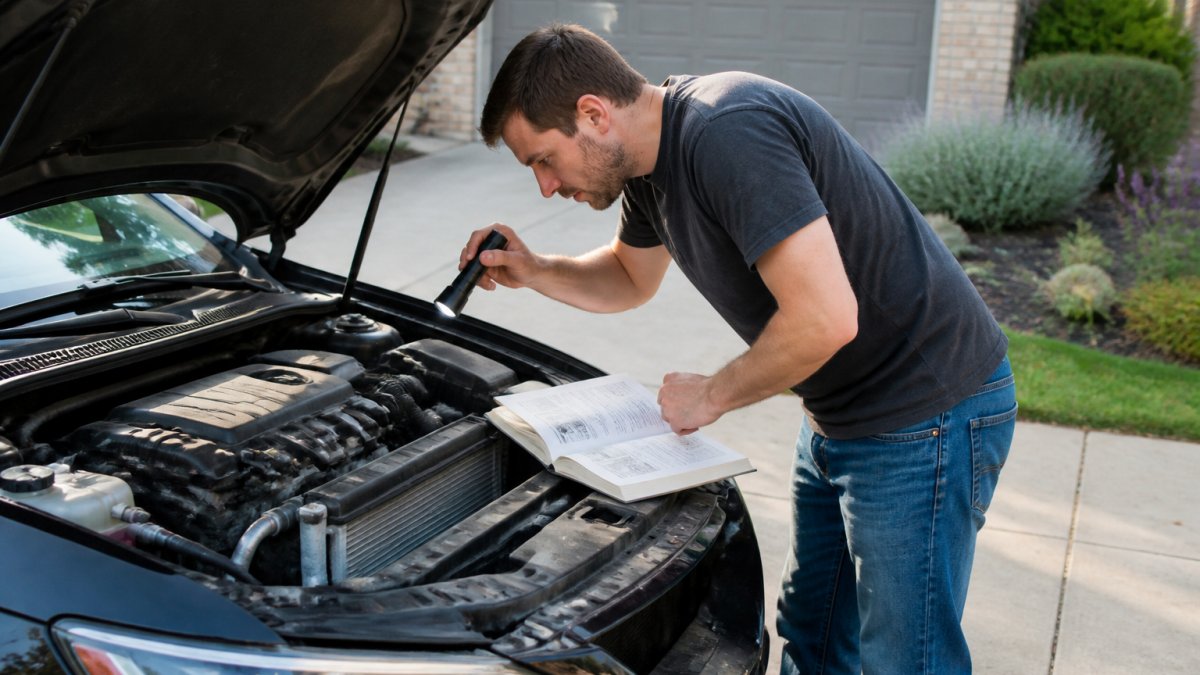
Some checks are safe for anyone. Others need gauges, a recovery machine, and training. Here's the line we draw.
Safe to do yourself:
- Watch the condenser fan with the AC running
- Replace the cabin air filter
- Clear leaves and bugs from the condenser fins with a soft brush
- Note exactly when cold air stops, and whether driving speed changes it
- Check that the AC button and blower settings actually engage
Leave to a certified technician:
- Adding or recovering refrigerant, which requires EPA Section 609 certification
- Leak detection with UV dye or electronic sniffers
- Compressor, clutch, or expansion valve replacement
- Evacuating and recharging the system to the correct weight
Refrigerant handling is regulated under EPA Section 609 rules for motor vehicle AC, and venting refrigerant is illegal. That's not a rule to work around in the driveway.
If the DIY checks point past your comfort level, our full list of services covers AC diagnostics and repair so you know what to ask for.
Schedule an AC Diagnostic at Mason Street Auto Care
Guessing at an AC problem gets expensive fast. A proper diagnostic starts with system pressure readings, a visual leak inspection, and a fan and airflow check, and it ends with a clear answer instead of a parts list.
At Mason Street Auto Care, our ASE-certified technicians back every inspection with photos, so you can see the leak or the worn clutch for yourself. You get a clear estimate before any work starts, and our work is warranty-backed. No surprise line items.
When you're ready, book an AC diagnostic online or call the shop. Tell us when the air goes warm, and we'll take it from there.
Frequently Asked Questions
Why does my car AC stop blowing cold air after a while?
The most common reason is a low refrigerant charge caused by a slow leak. As the system runs, pressure drops and the compressor cycles off to protect itself, so cold air fades. A failing compressor clutch, a blocked expansion valve, or a condenser that cannot shed heat can cause the same pattern. A technician can measure high-side and low-side pressure to tell which one applies to your vehicle.
Can low refrigerant make my car AC stop cooling, and what are the symptoms?
Yes. Low refrigerant symptoms in car AC include cold air at start-up that turns warm within minutes, weak airflow from the vents, the compressor cycling on and off quickly, and a faint hissing or bubbling sound. Refrigerant does not get used up, so a low level means there is a leak. Adding refrigerant without finding the leak usually leads to the same problem returning.
Why does my car AC work at speed but not at idle?
A car AC not cooling at idle usually points to airflow over the condenser. At speed, ram air pushes heat out of the condenser; parked or in traffic, the condenser fan has to do that job alone. A failed fan, a clogged condenser fin, or a weak compressor will show up as warm air when you stop. Have the fan and condenser inspected before replacing parts.
Is it safe to keep driving when the car AC stops cooling?
Driving with a warm AC will not damage the engine in most cases, but it is a warning sign worth acting on. If you also notice a burning smell, unusual noise from the compressor, or the engine temperature climbing, stop and have it checked. Continuing to run a system with a failing compressor can turn a smaller repair into a full replacement, so book a diagnostic soon.
A warm vent on a hot commute is a small problem that grows into a big one if you ignore it. Mason Street Auto Care gives you a straight answer, photo-backed proof of what's wrong, and warranty-backed repair from ASE-certified technicians. Get started with Mason Street Auto Care and get your cabin cold again.